RE-VERB – Part II (Snowball Effect 5) – Northern Gaze, Aine Art Museum 22 August–16 November 2025
Sound artist and project initiator: Jaakko Autio / Sawotta Choir: Kaisa Björkbacka, Virva Eskelinen, Juha Hilander, Sarianna Joukainen, Erja Leinonen, Suvi Lyytinen, Auli Mikkonen, Hanna Nurmi, Jaakko Örmälä, Anu Pöntinen, Sonja Reinikainen, Touko Raatikainen, Inka Turunen, Tiina Väätäinen, Konsta Veijonen, Ville Heikkinen / Guest vocalists: Kasper Omenasaari and Reetta Karhunen / Saxophone: Anna Voutilainen-Veijonen / Exhibition artists: Jaakko Autio, John Court, Juha Allan Ekholm & Jussi Valtakari, Johannes Heikkilä, Pekka Homanen, Maria Huhmarniemi, Rosa Kansala, Jonas Karén, Savu Korteniemi, Markku Laakso, Elina Länsman, Pia Männikkö, Mayumi Niiranen-Hisatomi, Milla-Kariina Oja, Tommi Pasanen, Harriina Räinä, Saku Soukka, Meri Toivanen, and Tommi Yläjoki / Curator: Merja Briñón / Curatorial Assistant: Amanda Hakoköngäs / Exhibition working group: the teams of Aine Art Museum and Kemi Art Museum / Installation Setup: Aapo Suominen, Brita-Kaisa Välimaa, Jari Hannuniemi.
This page presents the latest Re-Verb version (Aine Art Museum/Kemi Art Museum 2025)—below you’ll find a description of previous Joutsa/KITA installations and the background process.
At the heart of both Re-Verb versions—at Aine Art Museum (Tornio) and KITA Gallery (Joutsa)—remains the question of the ever-changing relationship between sound and space, the interaction of the individual and the environment, and the experience of presence. The work establishes a relationship with the audience in which visitors do not simply become viewers of a performance, but are invited to inhabit the space freely, experience it at leisure, and discover anew their own bodily, listening presence and sonic agency.


RE-VERB – Part II (Snowball Effect 5) – Northern Gaze, Aine Art Museum 22 August–16 November 2025
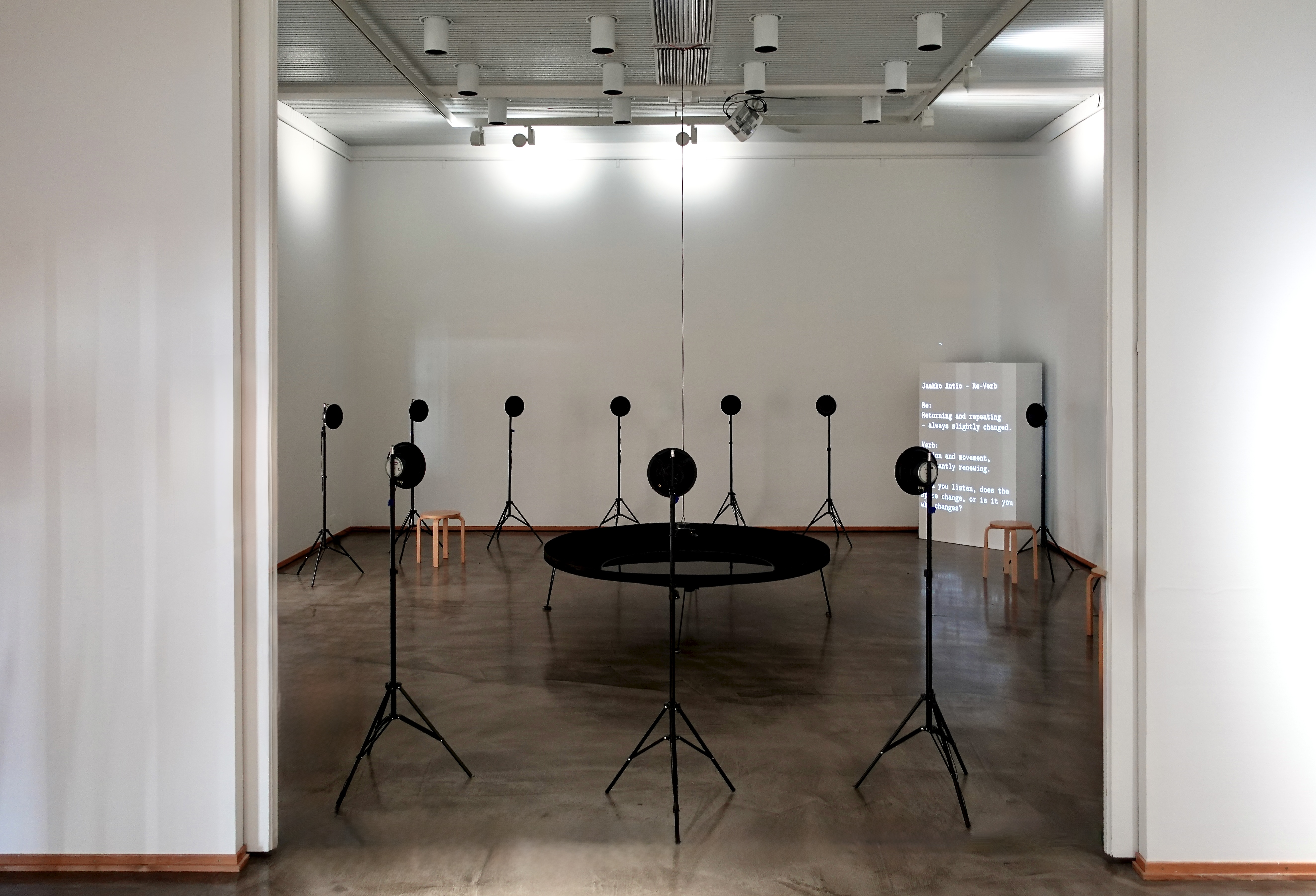
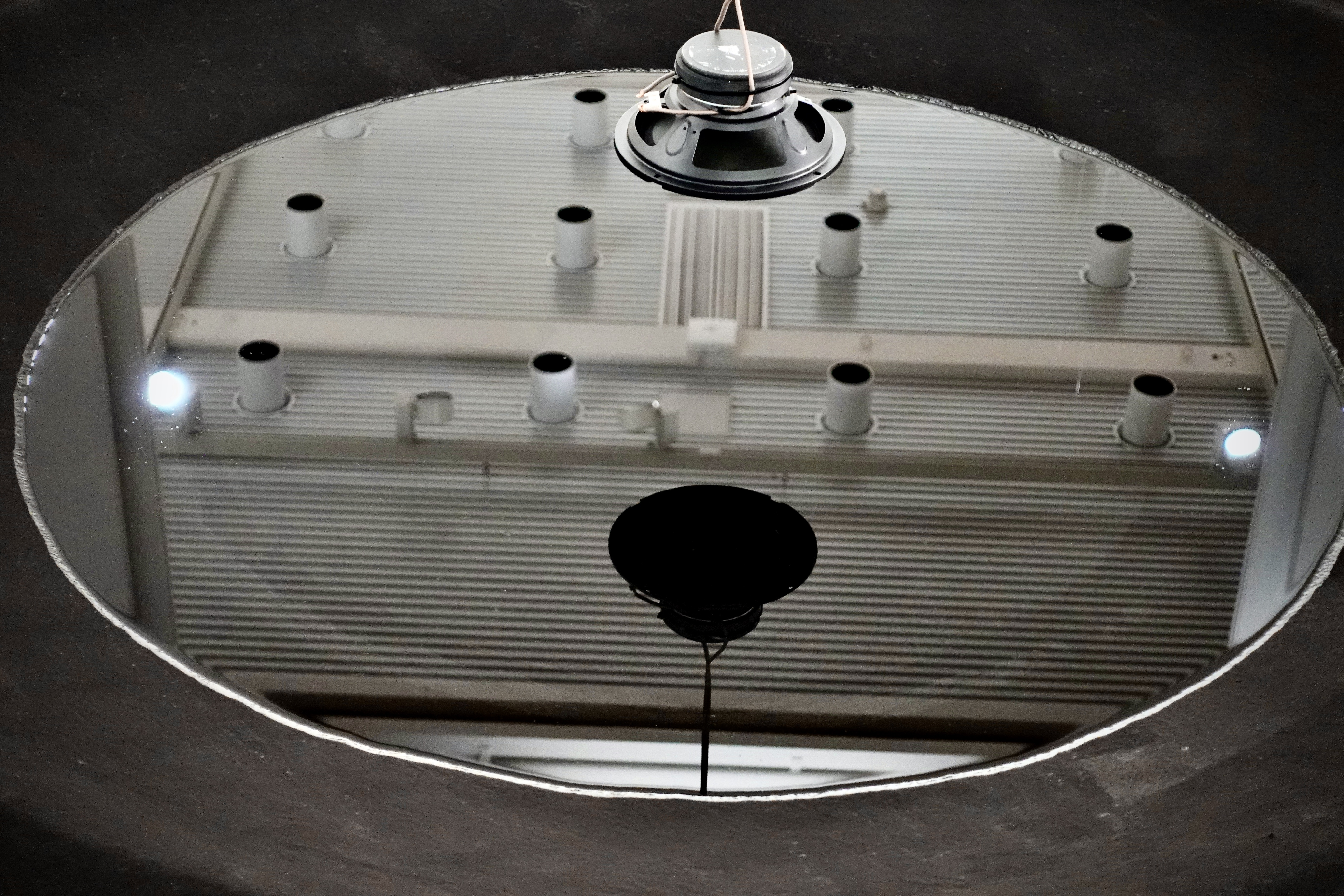
Re-Verb unfolds in its own dedicated room: the work consists of 17 speakers and a Mussou black-treated water speaker. The breaths are heard “dry”—without reverb—making the voices of individual singers stand out within the whole. The singing of Kasper Omenasaari and Reetta Karhunen, as well as Anna Voutilainen-Veijonen’s saxophone, resonate with a convolution reverb reminiscent of the space in the Taj Mahal, immersing voice and space into a continuum that opens up a connection to both personal and universal experience.
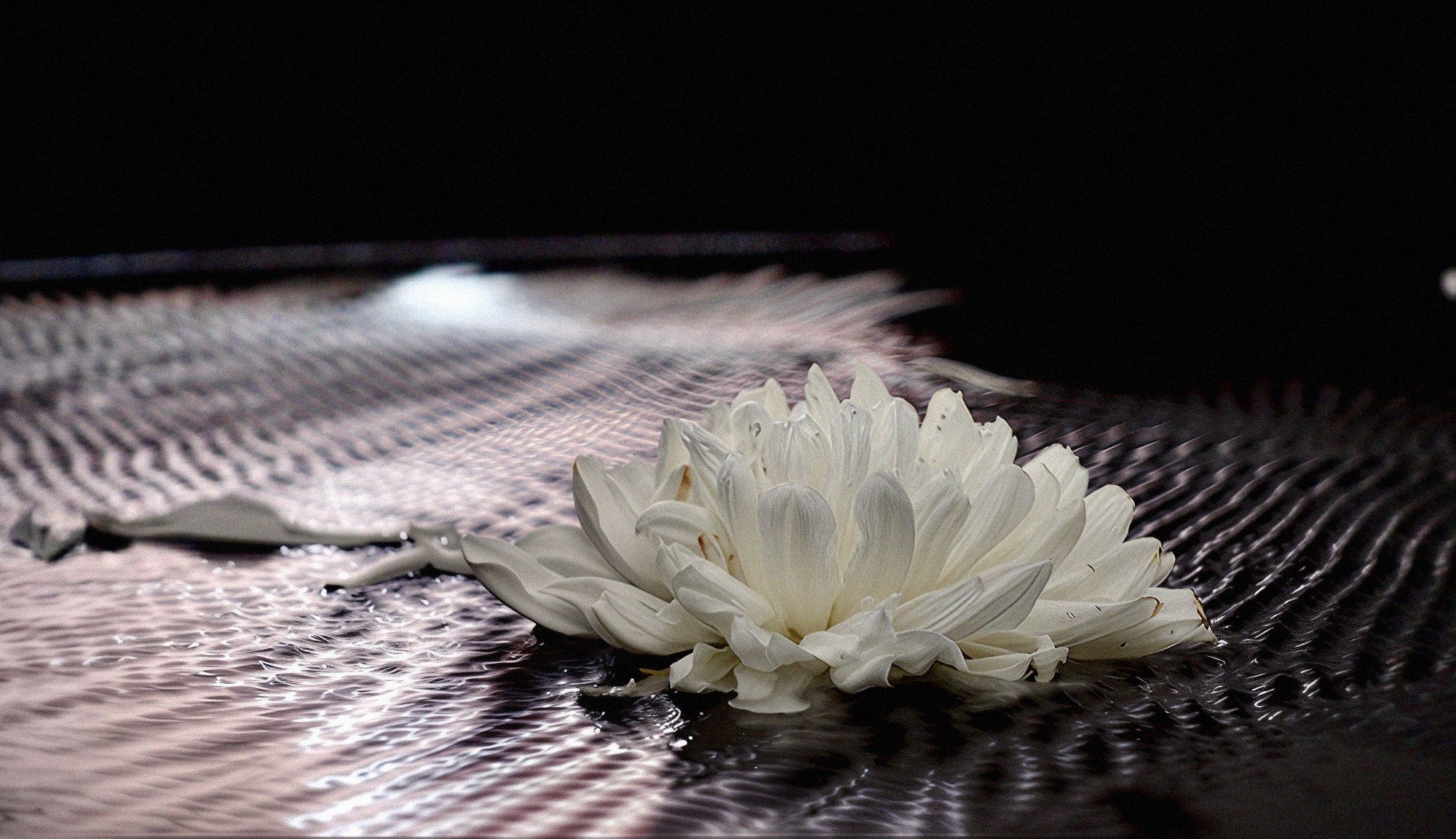
One speaker transmits sound directly into water: singing and the flow of water form a quiet dialogue, carrying a meditative, spiritual feeling—the spaciousness of surround sound, the vibration of water, and the fleeting nature of the human voice converge.
The basis of the whispered passages is a score composed by Anna Voutilainen-Veijonen—originally rehearsed in four parts, but in this version the form is dissolved almost beyond recognition. The saxophone and singing (by Kasper Omenasaari and Reetta Karhunen) are pure improvisation, as is Voutilainen-Veijonen’s playing.


About the Work
The central question of the Snowball Effect 5 exhibition is the connection between the moment, the body, and the environment. In Re-Verb, listening is an active, experiential process. At the core of the work are a whispering choir (Sawotta Choir and guest singers), a solitary saxophone, and water set into motion by breath and sound impulses. The acoustic space comprises 18 speakers and a visible water speaker, whose interplay serves as both an auditory and corporeal surface for experience.
The choir’s whispered voices do not form a conventional composition; instead, they dismantle the postures and attitudes associated with the gallery environment and high culture. In the face of ritualistic presentation, words and melodies lose their recognizability. Yet together, they build a nuanced, supportive soundscape that resonates with connections between birth, disappearance, and presence. The processes of attainment and restoration are ongoing; the reflection of sound in space and water is both a concrete phenomenon and a philosophical question.
When others enter the space, the private experience subtly shifts with each participant. I encourage visitors to recognize and embrace this change in their own sensitivity, in their own experience—and to welcome the transformed space. As listening continues and the senses remain alert, a quiet mutuality may arise: a shared peace that does not depend on individuals but is formed from an undefined, free togetherness.
Re-Verb explores the theme of togetherness. Community here is born from sharing the space and jointly exposing oneself to the thresholds of silence, breath, and sound—not from background identity. The role of the visitor is emphasized: the installation enables a deepening into the constant transformation of sound and space, and the body’s sensitization to the vibrations of sound waves and water. This heightened experience is a continuum that can extend beyond the space into the surrounding landscape, such as the flow of the Tornio River or the movement of the wind as one steps out of the gallery. One may suddenly awaken to it again upon returning outside.
Re-Verb resonates with the themes of the Snowball Effect 5 exhibition by emphasizing the importance of those moments in which personal health—the ability to sense, breathe, and recover—becomes the foundation of existence. At the same time, the work asks: What happens when we allow ourselves to listen, to pause, and to breathe?
The piece puts metaphor aside, focusing instead on experience, sensation, and the quality of listening. It does not align with any single tradition but offers itself as a secular-sacred ritual space, where the visitor can relinquish the role of mere spectator: to encounter, to build connection, and to attune individually and bodily.
The simplicity of the instrumentation (saxophone, voice, breath choir, water) creates a space where every moment can be restored and renewed. The sonic tapestry is constantly changing, and the acoustics of the space actively participate in shaping the experience.
In Re-Verb, technology and bodily action form a unified process. The work is not meant to be an intellectual metaphor but to create conditions in which the traces of experience—the echoes of space, the continuity of breath—become joined with the architecture. When you listen, is it the space that changes, or is it you who change?
RE Series 2025
The RE series explores the significance of space, sound, and community in contemporary art. In 2025, works from the series will be presented at Möhkö Ironworks Museum (Re-Ditus, 1 June–31 August), Gallery Villa Suruton in Savonlinna (Re-Floris, 12 June–16 August), the House of Kinetic Art (KITA) in Joutsa (Re-Verb, 28 June–31 August), the Lappeenranta Riverside Biennale at Halkosaari Pavilion (Re-Ditus, 5 July–31 August), Aine Art Museum in Tornio (Re-Verb – Chapter II, 23 August–16 November), MUU Gallery in Helsinki, and Taiteen talo in Turku.
Snowball Effect 5 – Northern Gaze
Snowball Effect 5 – Northern Gaze is an extensive contemporary art exhibition jointly produced by two art museums. It highlights current phenomena in the northern Finnish art scene, themes of community, and questions of landscape and identity. The exhibition includes a total of 20 artists, each of whom has a connection to Northern Finland—the artists and works were selected via an open call overseen by an invited curator. The tradition of the Snowball Effect exhibition emphasizes collaboration, participation, and the position of northern actors: in smaller localities, art emerges under different circumstances than in large cities, which is reflected in both subject matters, materials, and unique modes of community practice.
Disciplines—painting, sculpture, sound and media art—meet in the exhibition’s spaces, where audiences not only view but also participate in and touch the art. For example, in Pekka Homanen’s work “From Wordless to Word,” viewers can form words from letters, influencing the work’s message about bullying. At Kemi Art Museum and Aine Art Museum, themes of northern nature, cultural tensions, and community are prominent: in the sculptures, video works, and installations, the arctic transformation, the experience of outsiderness, and the uniqueness of the northern landscape are strongly present. Snowball Effect 5 challenges us to examine how the environment and social landscape affect art and how art itself can create spaces for encounters, perception, and empowerment within communities.


The photo collection presents the participatory and sensory works of the Snowball Effect 5 exhibition: Jaakko Autio’s Re-Verb installation enables the experience of sound as the vibration of water; in Pekka Homanen’s “From Wordless to Word” sculpture ensemble, the audience forms words from letters as part of a work addressing the theme of bullying; Saku Soukka’s video work explores the inner world of people in the North; and Pia Männikkö’s kinetic installation “Kaskadi” moves through the space like a wave-like breath. Photos: Richard Kautto.
Re-Verb @ House of Kinetic Art (KITA), Joutsa 28 June–31 August 2025
Sound artist and project initiator: Jaakko Autio / Composer: Anna Voutilainen-Veijonen / Performed by Sawotta Choir: Kaisa Björkbacka, Virva Eskelinen, Juha Hilander, Sarianna Joukainen, Erja Leinonen, Suvi Lyytinen, Auli Mikkonen, Hanna Nurmi, Jaakko Örmälä, Anu Pöntinen, Sonja Reinikainen, Touko Raatikainen, Inka Turunen, Tiina Väätäinen, Konsta Veijonen, Ville Heikkinen / Guest vocalists: Kasper Omenasaari and Reetta Karhunen / Saxophone: Anna Voutilainen-Veijonen / Installation Setup: Jaakko Autio & Tuomo Vuoteenoma / Other artists in the exhibition: Petri Eskelinen, Vilja Joensuu, Mika Kiviniemi, Elena Laurinavičiūtė, Henna Nerg, Simonas Nekrošius & Tuomo Vuoteenoma / KITKA exhibition curators: Tuomo “Tunkki” Vuoteenoma & the KITA team: Mimosa Pale, Johanna Pahalahti, Risto Puurunen, Maija Sydänmaanlakka, Elli Toivoniemi, and Arlene Tucker. / Supported by a 6-month working grant from the Arts Promotion Centre Finland.
In both Re-Verb versions—at Aine Art Museum (Tornio) and KITA Gallery (Joutsa)—the core remains the exploration of the ever-changing relationship between sound and space, the interaction of the individual and the environment, and the experience of presence.
The work establishes a relationship with the audience in which visitors do not simply become spectators of a performance, but are free to inhabit the space, linger within it, and rediscover their own bodily capacity to perceive and produce sound.
RE-VERB is an immersive sound installation by Jaakko Autio, in which 16 loudspeakers form a breathing, multidimensional network within the space. Each speaker plays back the whispers and rehearsal moments of individual singers, recorded with their own microphones—the sound surrounds the listener, and the space becomes a living, breathing entity. The material of the work consists of whispered singing and rehearsal sounds by the Sawotta Choir, based on a composition by Anna Voutilainen-Veijonen.
Sound and Space
RE-VERB draws on the tradition of sound art, where sound is seen as a transient, immaterial phenomenon unfolding in time. In this piece, sound is not merely to be heard but to be experienced—an intimate whisper and breath become a bodily, contemplative sensation. The listener is not a passive observer but an active part of the space and the moment: you are the art. The space allows for deep immersion, in which both the environment and one’s own body become perceptible in new ways, and every moment is built on a renewing foundation.
The title Re-Verb refers both to the effect of reverb, where sound reflects and fills the space, and to a return to the origins of sound and expression. Mentally, the name invites us to return to a state of listening and presence, where every whisper and breath gains meaning—and sound becomes a connection with both the space and with others.
RE-VERB is part of the KITKA / FRICTION exhibition, which explores friction as both a physical and emotional force. I approach friction through whispering and breathing: the friction between the vocal cords and air becomes a sound, which is not only a physical phenomenon but also an emotional touch. The act of whispering is reminiscent of breath observation in meditation. Whispering is the most delicate form of human vocalization—it requires closeness, fragility, and trust. In this work, it becomes a human experience, where sound is not only to be heard but to be sensed and felt.
Before words, there is silence, breath, presence that can be felt as the continuity of contraction and expansion. Our culture is built on words, but every conversation, encounter, and connection begins from the moment someone dares to break the silence. Who speaks first? Who has permission to use words? Who determines the subject of conversation, who sees the furthest? These are core questions of human interaction, which also resonate in this piece: sound is always more than just sound—it is presence, encounter, connection-building. Re-Verb invites the listener to pause with these questions, to rest in a state of feeling mind and body-mind connection, where words are only one part of the whole.
The piece situates itself within a continuum where bodily experience, space, and technological environment intertwine. Sound, breath, and movement form a whole in which the interaction between listener and space is in constant flux—the work is always recreated in the interplay of participant, space, and technology. Such an approach has also become central in contemporary choreography: it is no longer just about presenting a finished artwork, but about how the human and the non-human, the body and technology, together can create new, open, and participatory experiential worlds. In RE-VERB, space, sound, and body are not separate but together construct a processual and somatic totality that sustains and creates a safe condition for openness and transformation.

Collaboration
This work was created in the spirit of friendship and community. The singers of the Sawotta Choir and Anna Voutilainen-Veijonen have contributed their time and talent without financial compensation—each voice is a gift that helps to build a shared space. My collaboration with Anna has been especially meaningful to me: I strive to nurture and highlight those qualities I admire in my friend. When Anna sings, plays, or composes, I can hear the same sensitivity and thoughtfulness that come through in her conversation.
There has been something profoundly honest in our collaboration—something that rarely finds its way into finished artistic texts. I am grateful for Anna’s trust and openness—for the way she has allowed her own color, her own shade of blue, to resonate in this work. In the introductory video, the blue water flowing next to KITA Gallery and Anna’s saxophone form a prelude to this piece—a visual and sonic painting of gratitude and presence. Blue is the color of this work: the feeling mind.
Our collaboration has been built from small gestures—sharing a bottle of wine, lending a microphone, covering the costs of a recording space, or simply offering encouragement when resources have been scarce. These moments, often invisible to outsiders, are the foundation of all collective creation. The process has included quiet wisdom and humility, a willingness to give without expectation of return. Sometimes I have wondered if I take too much or am being selfish, but I know that the purity of intention and the honesty of connection are what matter most.
The RE series explores the significance of space, sound, and community in contemporary art. In 2025, the series features works at Möhkö Ironworks Museum (Re-Ditus, 1 June–31 August), Gallery Villa Suruton in Savonlinna (Re-Floris, 12 June–16 August), House of Kinetic Art (KITA) in Joutsa (Re-Verb, 28 June–31 August), Lappeenranta Riverside Biennale at Halkosaari Pavilion (Re-Ditus, 5 July–31 August), and in the autumn at Aine Art Museum in Tornio (Re-Verb, 23 August–16 November), MUU Gallery in Helsinki, and Taiteen talo in Turku.