BORDER SERIES II: OrigiNation (2023)
M_itä Biennial, Joensuu Art Museum, Finland
Part II of the Border Series (2022–2025)
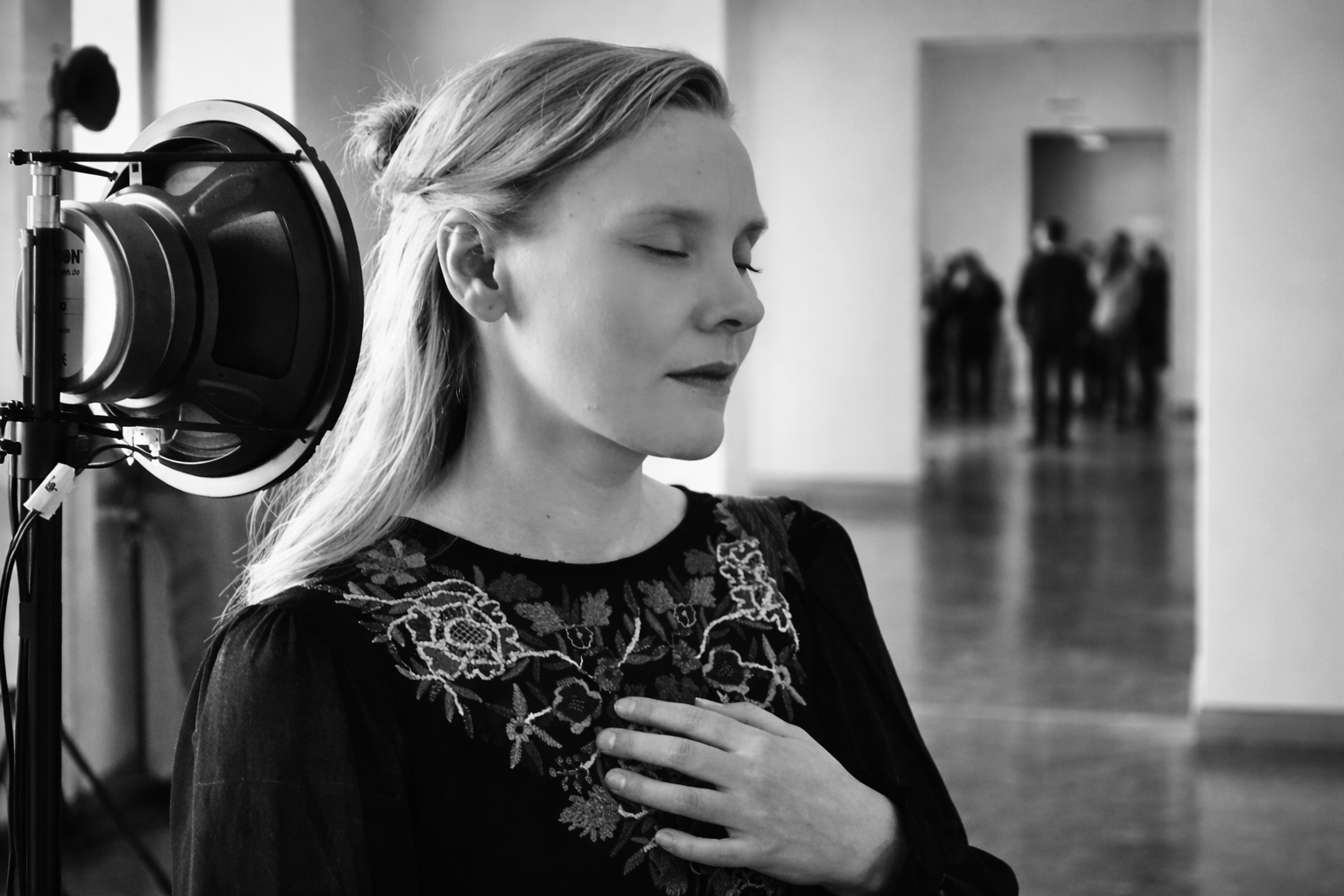
Listening — Joensuu Art Museum (2023)
An intimate moment of listening inside the installation. We do not see the face of the listener. We witness the act of listening itself.
On the Border had taken everything it could take. The war continued. I had no more external force to draw from.
I returned to Narva, this time without crisis. I went back to record again, to see what remained when pressure lifted.
The M_itä Biennial asked about the east. Borders between places, bodies, relationships. I applied knowing no one else was making work quite like this. They selected me.
The condition was that the work had to be new. On the Border had not been shown in Finland, but that was not enough. I called Johanna Rannula at NART and asked if I could return for a week to record. She said yes.
This time I moved from structure toward improvisation.
The idea was simple: in improvisation, a person meets themselves. The resistance to being authentic. The same resistance I encounter when trying to tell any story honestly.
Together with Jussi Mattila I developed a framework. Not free form, but structured enough to hold. In Narva I recorded young pop and jazz students with their teacher.
They chose to sing the words of the Estonian national anthem, mu isamaa, ei vetta rantaa, my homeland, no shore of water.
The singing was technically extraordinary. Underneath it, homelessness. That they could sing those words without breaking apart.
Their teacher was a force of nature. Skill as survival. Form as navigation through difficult circumstances.
When I asked them to improvise freely, they said:
We can improvise if you give us the sheet music for it.
It made me laugh. It also said everything.
Freedom is not instinctive. It has to be learned. Perhaps that is also political.
We recorded. I asked each singer the same question I had asked in Finland: Why is it important to sing?
I was searching clumsily for the idea that singing makes a person free. They were patient with me.
The Installation
The space at Joensuu Art Museum was bare. No visuals. Just listening. The sound spread through the entire building. No beginning. No end.
The work cycled. A computer drew fragments of interviews in Finnish, Russian, Estonian and English.
At moments the Narvan singers sounded like birds. A different quality from the Finnish voices, yet in harmony. Something in the sound had already shifted toward the future.
Before the opening I spoke with Pauliina Kaasalainen in the corridor. She told me that all institutional collaboration with Russian museums and communities had been cut. There had once been ordinary exchange across that border. It was over.
She was not making a political statement. She was stating a fact.
This work is a small gesture against that ending.
Not a grand one.
Quieter than On the Border. Less catharsis. More searching.
The external force was gone. What remained was the question of how to continue when you cannot change the outside world.
You turn inward. You improvise. You try.
Installation Structure
A spatial multi channel sound environment in which individual voices emerge, intersect and dissolve. Singers respond as individuals, not representatives of nations.
Fragments of Maamme and Mu isamaa are reconfigured into clusters of breath, wind and deviation. No longer symbols of sovereignty, but material for internal decision making.
The listener stands inside the field. Not as observer, but as participant.
The work does not resolve identity. It stabilizes attention.
M_itä Biennial Overview
Artist Interview (in Finnish)
In this Finnish language interview, Autio reflects on the Narva residency origins of the work and on improvisation as a practice of inner decision making.
Critical Review
“On the borderline between the recognizable and the unrecognizable, devoid of sharp contours, AlkuLähde refers to the reality of detachment from oneself, from the individual, groping beyond narrative, human created boundaries. The cluster is multifaceted; a convergence of wind, human, and bird. It ends in a surplus conversation from a song, where one of the singers poses an amused but very pertinent question contemplating finitude: ‘Is it allowed to deviate from the plan?’ This statement raises questions encapsulating the exhibition’s themes about what happens if detachment is not optional, but mandatory, a forcible tearing away or alienation dictated by societal structures.”
Tuija Huovinen, Mustekala Cultural Magazine
Credits
Sound Artist and Convener: Jaakko Autio
Music Collaboration: Jussi Mattila
Participating singers: Finnish, Estonian and Narva based vocalists
Commissioned by M_itä Biennial, Joensuu Art Museum, 2023
 Jaakko Autio — Contemplative Spatial Sound Art