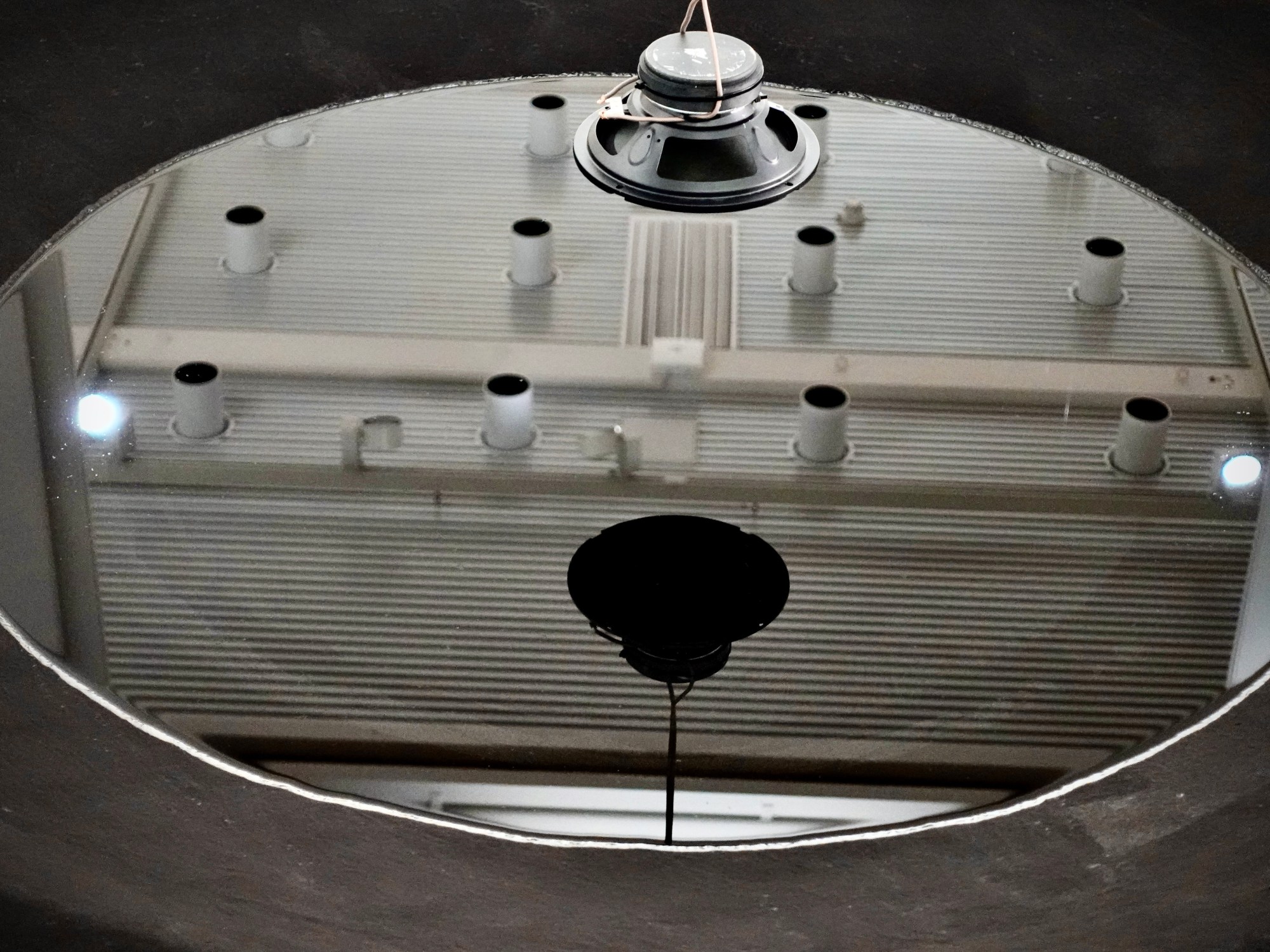
WRITINGS
These texts articulate the spatial and philosophical foundations of my installations.
They are not commentaries on finished works. They attempt to clarify the structural field in which the works operate.
My installations are often experienced as immersive or meditative. Without articulation, they risk being interpreted as aesthetic atmospheres, technical constructions or spiritual gestures. Writing is a way of defining the position from which the work emerges.
If I do not articulate this ground, someone else will do it for me.
These texts are an attempt at methodological transparency. They describe the compositional constraints and spatial decisions through which attention can refine itself without coercion. I am not interested in producing meditative effects. I am interested in building conditions where perception can reorganise on its own.
Some texts originate in earlier research from 2008, others in current practice from 2026. Together they trace a development in how I understand space, listening and the field. They do not present a doctrine. They map a working process.
The following text introduces the spatial logic underlying my installations.
SPATIAL DRAMATURGY
On multi-channel sound as architecture
2026
My installations are not compositions placed in space. They are spatial situations that unfold through listening.
I work with multi-channel sound as architecture. Sound is not background or illustration. It defines orientation, proximity, gravity and distance. It creates a field in which the body negotiates its position.
Space is never neutral. It has a centre and a periphery, zones of intensity and zones of rest. I often structure installations with a concentrated core and softer edges. The centre holds density. The periphery allows breathing.
Visitors are not spectators. They move inside the field. Their bodies complete the work.
Individual speakers function as presences rather than devices. Standing close to one voice is different from standing within the distributed field. Listening becomes directional, relational and embodied.
Time is spatial here. The work does not progress linearly. It circulates. One can enter at any point and remain as long as needed. There is no demand for completion.
FORM AND OPEN CENTRE
On proportion and restraint
2026
Perceptual decentralisation does not occur by accident. It depends on proportion.
Distance between speakers, calibrated levels, symmetry and restraint determine whether a field remains distributed or collapses into hierarchy. If one channel dominates, hierarchy returns.
Silence is not absence. It is structural tension. Restraint is not weakness. It is load bearing.
What might appear as an empty centre is not a void but an open condition, a centre that does not assert sovereignty. It is constructed through precision so that perception can circulate without being forced.
Form makes decentralisation possible.
LISTENING AND THE UNFIXED SELF
On redistributed orientation
2026
Listening is often described as an act performed by a stable subject.
Multi-channel sound complicates this structure. When sound arrives from multiple directions, orientation cannot be maintained from a single axis. Attention shifts laterally and proximally. Perception redistributes.
The listener does not disappear. But the listener is no longer sovereign.
This is not mysticism. It is spatial architecture.
Instead of “I hear a sound,” the experience approaches “hearing occurs here.” The self becomes relative within a shared condition.
My installations do not represent this shift. They stage it.
FIELD AND PRESENCE
On breath and relational space
2026
In works involving breath and distributed voices, each speaker functions as a point of encounter.
Proximity alters relation. Standing close to one voice differs from inhabiting the composite field. No source dominates. Plurality remains intact.
The work does not simulate community. It spatialises coexistence.
Presence is not centralised. It is distributed.
Visitors are positioned among others, human and non human, within a field of shared intensity.
Breath is not metaphorical. It is architectural.
INTENSITY REQUIRES RESTRAINT
On rhythm and confidence
2026
Continuous stimulation produces engagement but not necessarily depth.
When rhythm constantly propels experience, attention never stabilises. Energy disperses through variation.
Restraint introduces risk. Silence suspends control. In that suspension, perception must orient itself without being carried.
Intensity arises when potential is allowed to gather.
The strongest movement in a space is often the one that does not yet occur.
DECENTRALISATION IS NOT IMMERSION
On structural difference
2026
Much contemporary immersive work reproduces the very centralised subject it claims to dissolve.
Surrounding the visitor does not decentralise perception. It often intensifies it while preserving a coherent receiving centre.
Decentralisation redistributes perceptual gravity. No single axis stabilises the field. The visitor becomes one element among others.
The difference is structural, not stylistic.
Immersion consolidates experience. Decentralisation redistributes it.
FROM EMPTY SPACE TO FIELD CONDITION
On development and inhabitation
2008–2026
Earlier in my practice, I understood space and time as refined elements capable of revealing the structure of the self. Empty space confronted the ego with its relation to past and future. Silence exposed identity.
Space revealed the self.
This was necessary.
But revelation is not habitation.
There are moments when the field does not hold.
Before openings I have stood inside the installation and felt nothing but doubt. Not conceptual doubt but physical doubt. A tightening in the chest. A suspicion that everything is constructed too carefully and that the structure will fail under real presence.
During the installation of Re-Birth a suspension point gave way and I remained near the ceiling longer than planned, recalculating weight and tension. The geometry was precise. My confidence was not.
I know the pattern well.
It begins with a powerful idea. Then doubt enters quietly. Soon everything feels wrong. The work collapses internally and blame circulates in the wrong directions. At some point it stabilises again. An insight appears and suddenly the structure seems inevitable. In the end gratitude and blame are often misplaced, because the decisive shift cannot be narrated cleanly. The process resists linear reconstruction.
When the field finally begins to function, the recognition is not philosophical. It is bodily. A release. I usually step outside for a cigarette. I do not announce revelation. I simply notice that the structure no longer needs me to defend it.
This shift is fragile.
Depth is not harmless. Practices that loosen the self also expose fear. Without ethical alignment, without something like steadiness or goodwill at the centre, intensity can destabilise rather than clarify.
For this reason I no longer pursue peak states in the work. Wonder must be durable. It must survive silence, indifference and even the absence of reaction.
Over time my focus shifted from exposing the self to inhabiting a field condition in which the self remains relative. Space and time are no longer treated as primary themes but as assumed coordinates. What matters is relational movement within them.
The question is no longer “Who am I in this space?” It becomes “How does this field move now?”
In a field the self is permitted but not sovereign. Creative decisions arise as responses within a shared condition rather than as assertions of control.
Earlier work trusted empty space. Current work trusts the field.
This shift is not transcendence. It is structural permission.
TRANSPARENCY OF METHOD
On non coercive attention
2026
I am not interested in producing meditative effects. I am interested in avoiding coercion.
Rather than directing attention through climax or narrative propulsion, I construct constraints that reduce domination. Distributed sound, proportional geometry and rest intervals prevent perceptual fixation.
The work does not instruct belief. It constructs conditions.
I describe mechanisms rather than states.
Not transcendence but distribution. Not revelation but reorganisation. Not doctrine but proportion and restraint.
The field is not content. It is the structural condition in which content can appear and dissolve without being owned.
 JAAKKO AUTIO — SPATIAL LISTENING ARCHITECTURES